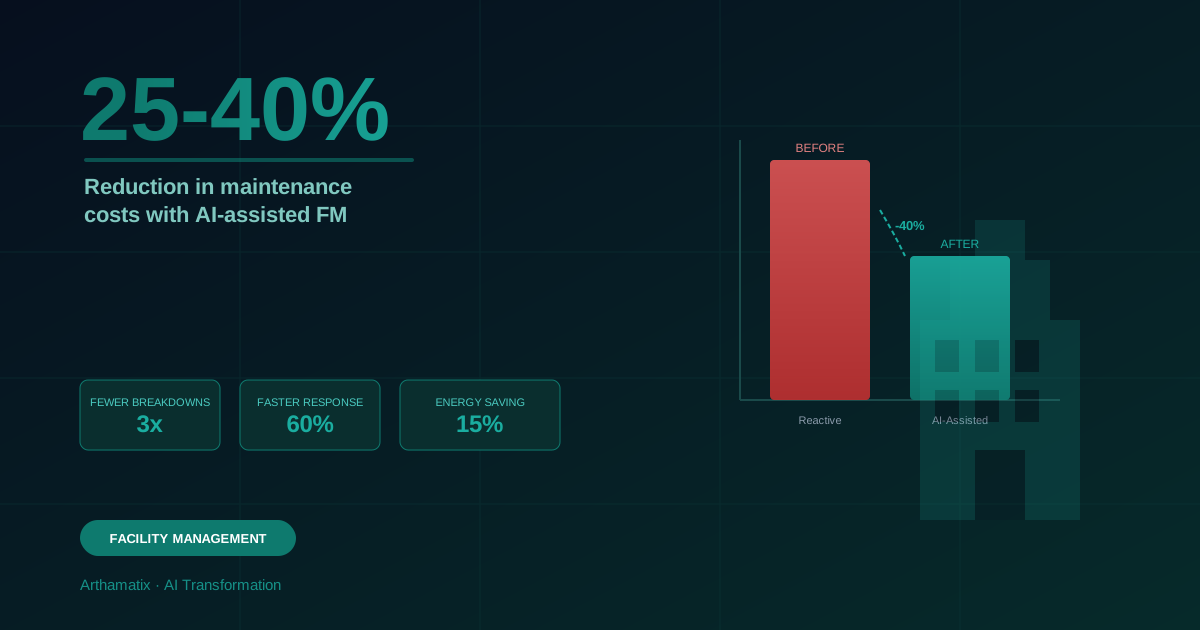

UAE facility management companies that have shifted from reactive to AI-assisted maintenance report 25 to 40% reductions in maintenance costs – and significantly fewer tenant complaints. The change does not require replacing your existing systems. It requires making them smarter.
The Real Cost of Reactive Maintenance
Every facility manager knows the cycle. Equipment fails. A complaint comes in. A work order is raised. A technician is dispatched. The repair is done – or a part is ordered, and the job sits open for days. Meanwhile, the next failure is already building somewhere else in the building.
The visible cost is the repair bill. The hidden cost is everything around it – the technician hours spent on diagnosis, the emergency parts procurement at premium prices, the tenant downtime, the follow-up complaints, and the supervisor time managing the chaos.
Studies of commercial FM operations consistently show that reactive maintenance costs 3 to 5 times more per asset than planned maintenance. In a large facility portfolio across the UAE – where summers push HVAC systems to their limits and energy costs are significant – that multiplier adds up quickly.
Why Switching to Planned Maintenance Is Harder Than It Sounds
Most FM software already has a preventive maintenance module. Most FM teams already know they should be using it. The gap is not awareness – it is execution.
Preventive schedules require accurate asset data. Asset data is usually incomplete, outdated, or scattered across spreadsheets and legacy systems. Schedules get created but not followed because technicians are pulled to reactive jobs. Work orders pile up. The planned maintenance backlog becomes as unmanageable as the reactive one.
The fundamental problem is that FM operations generate enormous amounts of data – work order history, asset age, failure patterns, technician notes, energy consumption – but almost none of it is being used to make better decisions. It sits in systems that store it without analysing it.
What AI-Assisted Work Order Management Changes
AI does not replace your FM platform. It makes it act on the data it already holds. The practical outcomes for UAE FM companies typically look like this:
- Failure prediction – AI models trained on your asset history and maintenance logs identify which assets are most likely to fail in the next 30 to 90 days, so you can act before the failure rather than after
- Work order prioritisation – instead of a queue sorted by submission time, work orders are ranked by asset criticality, location clustering, and technician skill match – reducing travel time and improving first-time fix rates
- Parts intelligence – patterns in historical work orders reveal which parts fail together, enabling smarter stock decisions and reducing emergency procurement
- Tenant communication automation – routine status updates, access confirmations, and completion notifications sent automatically, eliminating a significant coordination burden from FM staff
None of these capabilities require replacing your CAFM system. They work alongside it, processing the data it already captures and surfacing recommendations your team acts on.
The UAE Context: Why This Matters More Here
The UAE commercial real estate market has specific characteristics that make AI-assisted FM particularly valuable.
Extreme summer temperatures put HVAC systems under sustained stress for months at a time. Unplanned HVAC failures in July or August are not inconveniences – they are service level agreement breaches and potential health risks. AI-assisted condition monitoring and predictive scheduling for HVAC assets has a direct and measurable impact on the most critical failure risk in UAE facilities.
At the same time, the Dubai and Abu Dhabi real estate markets are increasingly competitive on service quality. Tenants have more choices. FM companies that can demonstrably deliver better uptime, faster response, and proactive communication have a competitive advantage – not just operationally, but commercially.
What a 25-40% Cost Reduction Looks Like
The cost reduction from AI-assisted maintenance comes from several sources that compound:
- Fewer emergency repairs – each prevented failure eliminates the premium cost of reactive response
- Better technician utilisation – optimised work order routing reduces wasted travel time, allowing the same team to handle more jobs
- Reduced parts waste – smarter stock decisions mean less capital tied up in slow-moving inventory and fewer urgent purchases
- Lower energy costs – assets maintained in good condition operate more efficiently, which is material in a market with high cooling loads
The 25 to 40% figure reflects operations where all these factors are optimised. In the first year of deployment, most FM companies see 15 to 20% cost reduction as the system learns your asset patterns – with improvement continuing in subsequent years as the model becomes more accurate.
Starting the Shift Without Disrupting Operations
The practical path for UAE FM companies is not a big-bang transformation. It is a focused pilot on a specific asset class – typically HVAC or elevators – where the failure cost and data availability make the ROI case clearest.
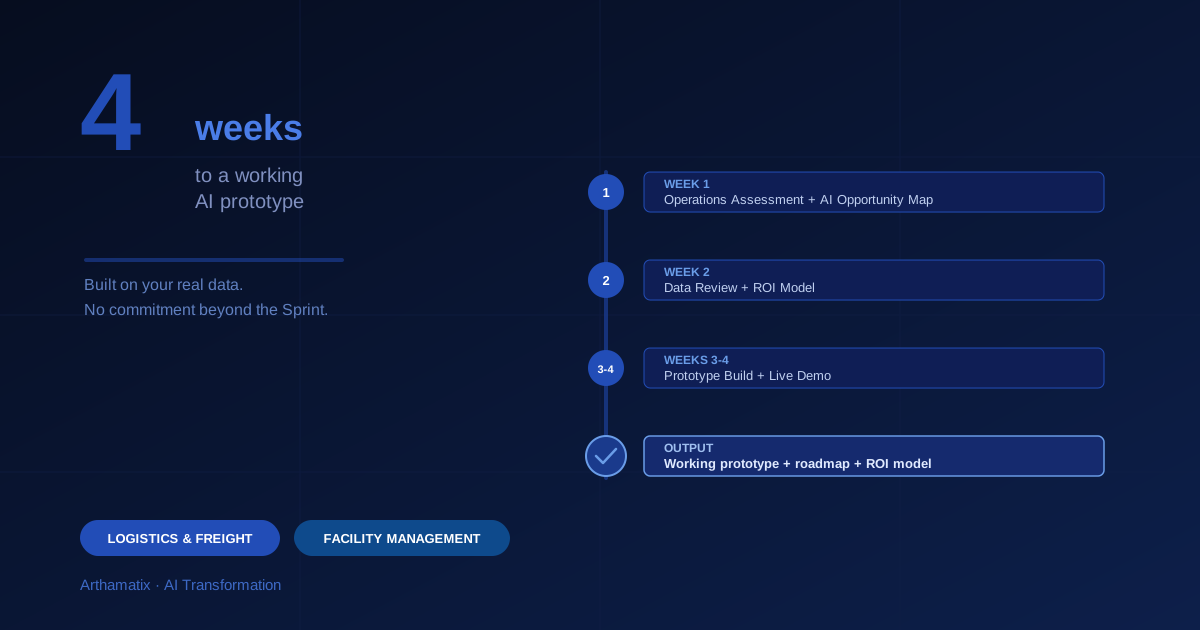
At Arthamatix, our AI Transformation Sprint for facility management starts by mapping your current work order patterns and identifying the highest-value automation opportunities within your existing data. In 2 to 4 weeks, we build a working prototype and give you a concrete picture of what the full deployment would achieve – before you commit to it.
If your maintenance costs are rising and your team is spending more time fighting fires than preventing them, the data to change that is probably already in your systems. Talk to Arthamatix about what it would take to put it to work.